
A data centre sells one thing above all: trust that the physical building is as hard to breach as the network. For the facility heads building and running data centres and IT parks across Pune and Navi Mumbai — now among India’s fastest-growing digital-infrastructure corridors — physical security is not a cost line, it is a clause in every client contract and every uptime audit. This guide explains how data-centre and IT-park security is actually layered, what auditors and hyperscale tenants look for, and how to brief a security partner that can pass their scrutiny.
Why data-centre security is a different discipline
An office guard controls who comes in. A data-centre security programme controls who touches what, when, and with what authority — down to a single rack — and proves it with a record that survives a third-party audit. The stakes are unusual: a few minutes of unauthorised physical access can mean a breach notification, a broken SLA, and a lost hyperscale tenant. That reframes the whole brief around three demands:
- Defence in depth: no single failure — a tailgater, a stolen badge, a bribed guard — can reach the servers.
- Provable access control: every entry and exit at every layer is authenticated, logged and reconcilable.
- Audit-readiness: the programme is documented to satisfy tenant, insurer and compliance reviews (uptime-tier, ISO 27001, SOC 2 physical-security controls) — not just to “look secure”.
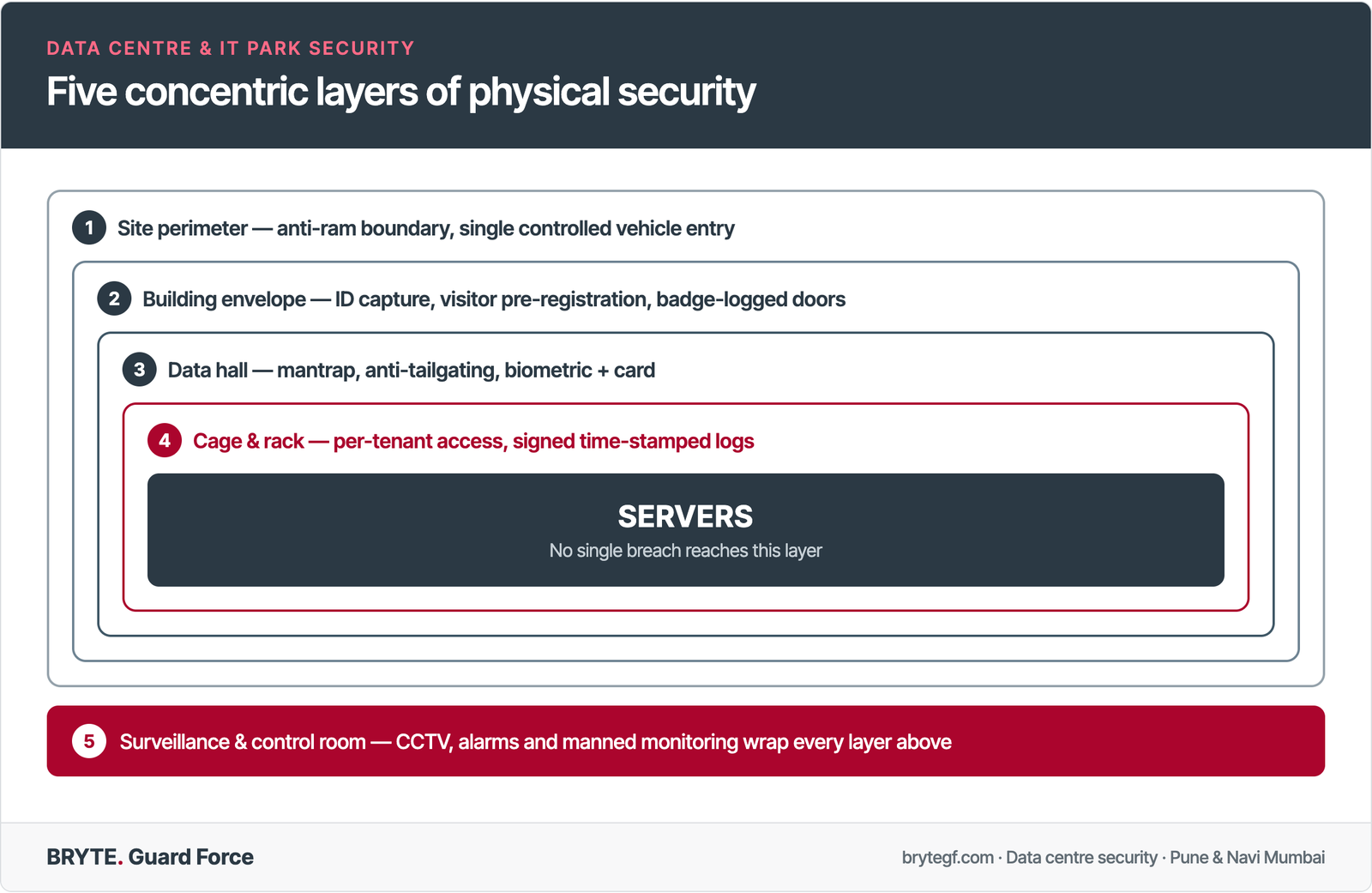
The five physical security layers of a data centre
A mature programme controls access at five nested layers, each with its own authentication and its own log:
- Site perimeter: boundary wall, anti-ram measures, a single controlled vehicle entry, and guards who verify every arrival against a pre-authorised visit — no walk-ins.
- Building envelope: reception with government-ID capture, visitor pre-registration, escort policy, and access-controlled doors that log every badge event.
- Data-hall access: a mantrap or airlock with anti-tailgating enforcement, biometric plus card authentication, and a rule that unescorted access is impossible for anyone without standing clearance.
- Cage & rack level: per-tenant cage access, rack-level locks, and a signed, time-stamped log of who opened what — the layer auditors probe hardest.
- Surveillance & control room: CCTV with retention, alarm monitoring, and a manned control room that ties every alert to a documented response — the layer that wraps all the others.
What a security team physically enforces (that technology alone can’t)
Access-control hardware fails open the moment discipline slips. The security team is what makes the layers real:
- Anti-tailgating: the most common physical breach is one authorised person holding the door for one unauthorised person. Trained officers enforce single-entry at the mantrap, every time, without exception or embarrassment.
- Visitor & vendor escort: OEM engineers, cooling and electrical contractors, and delivery crews are escorted and logged for the full duration — not badged in and forgotten.
- Two-person and access-window rules: sensitive work happens under dual control and within approved time windows, verified by the officer on post.
- Loading-bay and asset control: every drive, server and spare that enters or leaves is checked against an authorised asset-movement note — the data-centre equivalent of a factory’s material gate.
- Incident documentation: every anomaly becomes a time-stamped report that can be produced in an audit, not a verbal handover lost at shift change.
Pune & Navi Mumbai: India’s data-centre growth corridor
Physical location shapes the brief. Navi Mumbai has become one of India’s largest data-centre hubs — cable landing proximity, power availability and land have pulled hyperscale and colocation capacity into Airoli, Ghansoli and the wider node. Pune’s IT and engineering base around Hinjawadi, Kharadi and Talawade has driven both enterprise data centres and the IT/business parks that surround them. Two implications for security:
- Tenant expectations are global. Hyperscale and multinational tenants bring international physical-security standards; your guarding partner has to speak that language and produce that documentation.
- The campus is bigger than the data hall. IT parks and business parks around these facilities need integrated access control, visitor management, parking and patrol across the whole campus. See how we approach business parks and corporate campuses and corporate & commercial security.
Local buyer detail: our Pune and Navi Mumbai guides cover the wider market and pricing.
What auditors and tenants actually check
When a tenant’s or auditor’s physical-security reviewer walks your site, they are testing whether the programme is documented and disciplined, not whether it looks impressive. Typical checks:
| Area | What they verify |
|---|---|
| Access logs | Every entry/exit reconciles to an authorised person; no gaps, no shared badges |
| Visitor control | Pre-registration, ID capture, escort record for the full visit |
| Guard competence | Trained, PSARA-compliant, briefed on this site’s specific protocols |
| CCTV & retention | Coverage of all access points; footage retained per policy and retrievable |
| Incident records | Documented response to every alarm and anomaly |
| Statutory compliance | Valid licence, full statutory wages, PF/ESIC — clean principal-employer exposure |
That last row matters more than buyers expect: if your guarding vendor underpays wages or skips statutory dues, the exposure lands on you as principal employer. Verify it the way we describe in our PSARA compliance guide.
Briefing a data-centre security partner
- Insist on a site survey and a written protocol — post-by-post duties, access rules, escort policy, and escalation, mapped to your layers.
- Check training depth: data-centre posts need officers trained in access discipline and documentation, not general guards rotated in.
- Confirm reliever coverage and mobilisation SLAs so a post is never unmanned and a new facility is staffed on a committed date.
- Ask for the reporting you’ll receive: access exceptions, visitor logs, incident reports — the evidence that keeps you audit-ready.
- Look for integration: one partner covering security, front-office, housekeeping and technical support across the campus removes accountability gaps and overhead.
Bryte’s data centre & IT park security service is built around exactly this — layered access control, documented protocols, trained officers and audit-ready reporting, delivered locally across Pune and Navi Mumbai.
Frequently asked questions
What is physical security in a data centre?
Physical security is the layered control of who can physically reach the servers — from the site perimeter, through the building and a mantrap-controlled data hall, down to the individual cage and rack — with every access authenticated, logged and audit-reconcilable. It complements network security; a breach of either compromises the tenant.
What certifications should a data-centre security team support?
The guarding partner should be PSARA-licensed and able to operate and document to the physical-security controls your tenants and auditors require — commonly ISO 27001 and SOC 2 physical controls, and your facility’s uptime-tier requirements. They provide the manned enforcement and evidence those frameworks assume.
How is data-centre security different from office security?
Office security controls building entry. Data-centre security controls access at five nested layers down to the rack, enforces anti-tailgating and escort rules rigorously, and produces audit-grade records — because the consequence of a lapse is a client breach, not just an intrusion.
Do you cover IT parks and the wider campus, not just the data hall?
Yes. Bryte secures the full campus — perimeter, visitor management, parking, patrol and front-office — integrated with data-hall access control under one SLA, which is how IT and business parks in Pune and Navi Mumbai are best protected.
How fast can Bryte mobilise a data-centre or IT-park contract?
After a site survey and protocol sign-off, Bryte mobilises on a committed timeline with trained officers and guaranteed reliever coverage, so posts are staffed from day one.
Related guides
- Corporate Office & IT Park Security in Mumbai & Pune: A Facility Head’s Guide — the four-layer, audit-ready model for offices and parks.
- How to Choose a Security Agency in Maharashtra: A 10-Point Checklist — the audit-readiness questions to ask.
- Factory & MIDC Industrial Security in Maharashtra: A Plant Manager’s Guide — layered site security for high-value plant.
- Security & Facility Management Services in Pune: The 2026 Buyer’s Guide — the Pune market and pricing.
- Security & Facility Management Services in Navi Mumbai: The 2026 Buyer’s Guide — the Navi Mumbai data-centre corridor.
Make your building as trusted as your network
Your tenants audit the physical layer as hard as the digital one. Get a free quote and a Bryte specialist calls back within 4 business hours (Mon–Sat) to run a free site assessment and map an audit-ready security programme for your data centre or IT park. Or call +91 86523 45610.