
Choosing a security agency looks like a price comparison. It isn’t. Two agencies can quote for “one guard, 12-hour shift” and be selling completely different things — one a trained, insured, statutorily-compliant officer with real supervision behind him, the other a warm body whose low price is funded by an underpaid wage and skipped statutory dues that become your liability. This is the checklist facility heads, society secretaries and plant managers across Maharashtra use to tell the two apart before they sign — and before a cheap quote turns into an expensive problem.
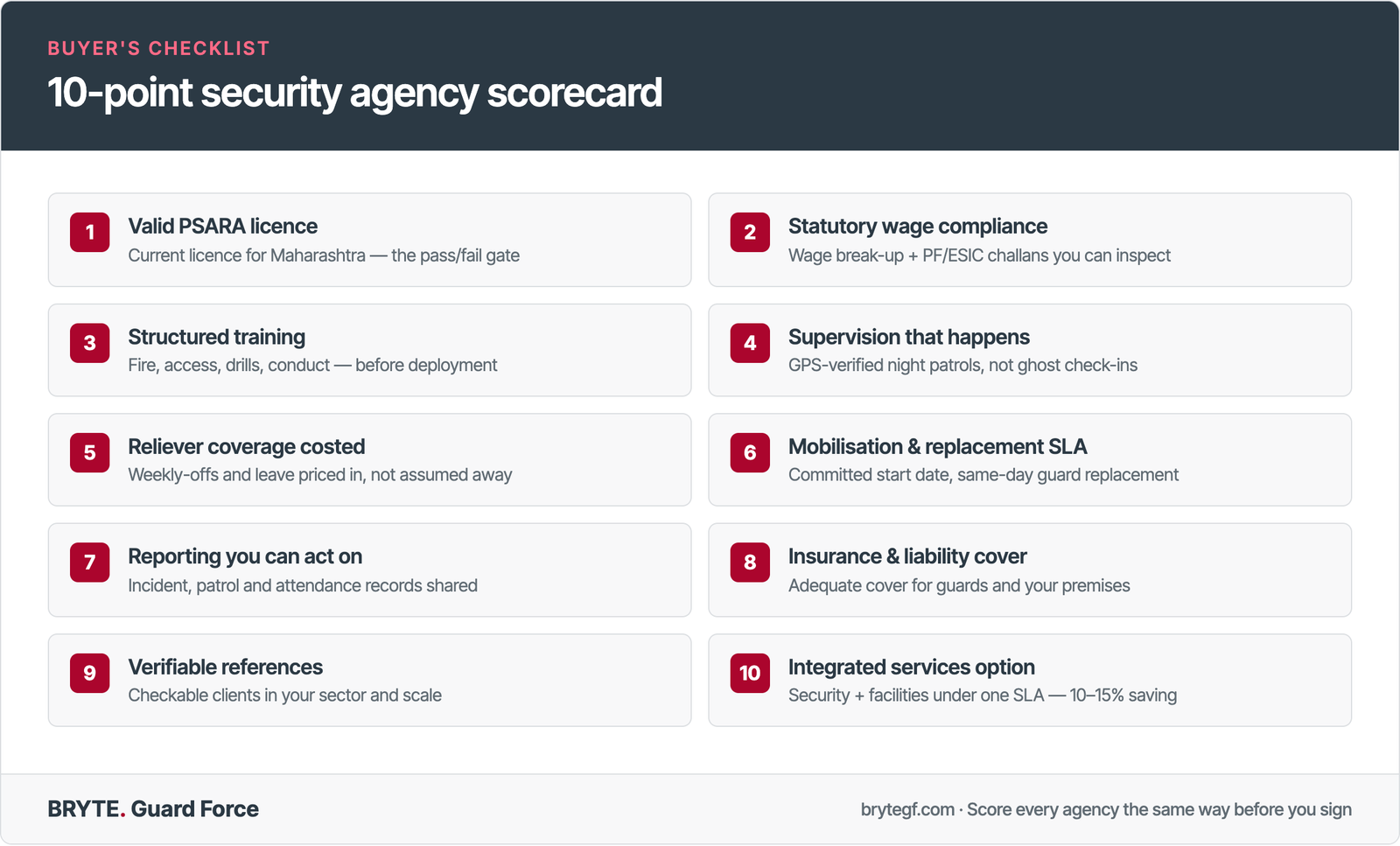
1. A valid PSARA licence for Maharashtra
Private security in India is regulated under the PSARA Act, and every legitimate agency must hold a current licence for the state it operates in. This is the pass/fail gate — an unlicensed agency is operating illegally, and deploying untrained guards is both unlawful and ineffective. Ask for the licence number and verify it. Our PSARA verification guide walks through exactly how to check.
2. Statutory wage compliance you can inspect
This is where most of the price gap hides. A compliant guard has a legally-mandated minimum cost — wages plus PF, ESIC and other statutory components. If an agency’s quote falls below that floor, the difference is coming out of the guard’s salary or out of skipped dues. As principal employer, you can be held liable for a contractor’s unpaid statutory dues. Ask for the wage break-up and last quarter’s PF/ESIC challans. Understand the real floor in our 2026 security guard cost guide, or model it with the cost calculator.
3. Real, structured training
PSARA mandates structured guard training, but depth varies enormously. Ask what training a guard receives before deployment and on refresh: fire response, access control, emergency drills, customer conduct, and site-specific protocols. A trained officer prevents incidents; an untrained one merely witnesses them.
4. Supervision that actually happens
A guard is only as good as the supervision behind him. The most common quality failure is “ghost supervision” — a field officer on the org chart who never visits at night. Ask how patrols and night checks are verified: GPS checkpoints and digital reports are real evidence; a signature in a register is not. This single factor separates agencies that improve over time from those that quietly decay.
5. Reliever coverage — the maths that proves the price
A guard cannot legally or safely work 12-hour shifts for 30 days a month. Real coverage prices in relievers for weekly-offs and leave. If a quote doesn’t show reliever arithmetic, it is quietly assuming your guard never rests — a safety incident and a compliance breach waiting to happen. Ask directly: “who covers the post on the guard’s weekly off, and is that person costed in?”
6. A committed mobilisation and replacement SLA
Ask two questions: how fast can you start a new site, and how fast do you replace an absent guard? A serious agency commits to a mobilisation timeline and a same-day replacement standard in writing. “We’ll manage” is not an SLA. Bryte replaces an absent officer within hours and mobilises new sites on a committed date.
7. Reporting you can act on
You should receive incident reports, patrol logs and attendance data you can actually review — not silence punctuated by a monthly invoice. Good reporting is how you catch a developing problem early and how you hold the agency accountable. Ask to see a sample report before you sign.
8. Insurance and liability cover
Confirm the agency carries adequate liability insurance and that its guards are covered. This protects you if something goes wrong on your premises and signals an agency that runs itself professionally rather than one operating hand-to-mouth.
9. Verifiable references and track record
Ask for references from sites similar to yours — same sector, similar scale — and actually call them. An established agency with a real client base and years of continuity is a lower risk than a new operator competing on price alone. Bryte has protected 1,000+ sites across 25+ Maharashtra cities since 1996, led by ex-servicemen.
10. Integrated services under one accountable partner
If you also need housekeeping, front-office, technical upkeep or parking management, an agency that delivers them under one SLA typically saves 10–15% versus separate vendors and removes the finger-pointing when an issue falls between security and facilities. Even if you only need guarding today, an integrated partner gives you room to consolidate later. See Bryte’s integrated security and facility management model.
Scoring it: how to compare quotes fairly
The trap is comparing prices for scopes that aren’t the same. Put every agency through the ten points above and normalise the scope first — same headcount, same shift structure, same reliever coverage — then compare price. A free site assessment does exactly this: it replaces guesswork headcounts with a mapped structure so you compare like for like.
| Signal of a strong agency | Red flag to walk away from |
|---|---|
| Surveys your site before quoting | Quotes a price over the phone, sight unseen |
| Shows wage break-up + PF/ESIC challans | Vague about statutory compliance |
| Costs relievers explicitly | Price only works if the guard never rests |
| GPS-verified patrols & digital reports | “Our supervisor checks regularly” |
| Written mobilisation & replacement SLA | “We’ll manage it, don’t worry” |
| Checkable references in your sector | Can’t name comparable clients |
Frequently asked questions
How do I verify a security agency is legitimate in Maharashtra?
Confirm a valid PSARA licence for the state, ask for the wage break-up with PF/ESIC challans, check training and police-verification records, and call references from comparable sites. Our PSARA guide covers verification step by step.
Why is one security quote so much cheaper than another?
Almost always statutory compliance. A compliant guard has a legal minimum cost; a quote below it is funded by underpaying wages or skipping PF/ESIC — dues you can be liable for as principal employer. Ask both agencies for the wage break-up and the gap explains itself.
What questions should I ask before hiring a security agency?
Ask for the PSARA licence, the wage and statutory break-up, the training programme, how patrols are verified, how relievers are costed, the mobilisation and replacement SLA, a sample report, insurance cover, and references in your sector.
Is the cheapest security agency ever the right choice?
Only if it’s cheapest at equal scope and full compliance — which is rare. Usually the lowest price signals cut corners (underpaid guards, no relievers, ghost supervision) that cost more later in losses, liability and turnover.
Should I use one agency for both security and housekeeping?
Usually yes. An integrated contract shares supervision overhead (typically 10–15% saving) and closes accountability gaps between security and facilities. Bryte delivers both under a single SLA.
Related guides
- Mumbai & Thane Security Guards Board Rates 2026: The Complete Breakdown — the official statutory rate card, role by role.
- Hotel & Hospitality Security in Maharashtra: The General Manager’s Guide — choosing a partner for the hospitality sector.
- Bank, ATM & Vault Security in Maharashtra: A Branch Manager’s Guide — compliance-first guarding for the banking sector.
- How Much Do Security Guards Cost in Maharashtra? The 2026 Rate Guide — the statutory floor every honest quote sits above.
- PSARA Compliance: How to Verify Your Security Agency Is Legal — how to check a licence and stay compliant.
- Factory & MIDC Industrial Security in Maharashtra: A Plant Manager’s Guide — what a real industrial programme looks like.
- Data Centre & IT Park Security in Pune & Navi Mumbai — briefing a partner tenants and auditors trust.
Compare Bryte against your checklist
Run us through all ten points — that’s exactly the conversation we want. Get a free quote and a Bryte specialist calls back within 4 business hours (Mon–Sat) to arrange a free, no-obligation site assessment that turns this checklist into a mapped, costed proposal for your site. Or call +91 86523 45610.