
A factory loses more to the quiet, daily leaks than to the dramatic break-in: a pallet that walks out on the night shift, scrap sold off the back gate, a contractor’s van that leaves heavier than it arrived, a fire door propped open for a smoke break. For a plant manager in Maharashtra, security is not a guard at a gate — it is a control system for people, vehicles, material and access across every hour the site is live. This guide sets out how industrial security is actually designed for MIDC plants and manufacturing sites, what separates a real programme from a warm body in a uniform, and what it costs in 2026.
What industrial security actually has to control
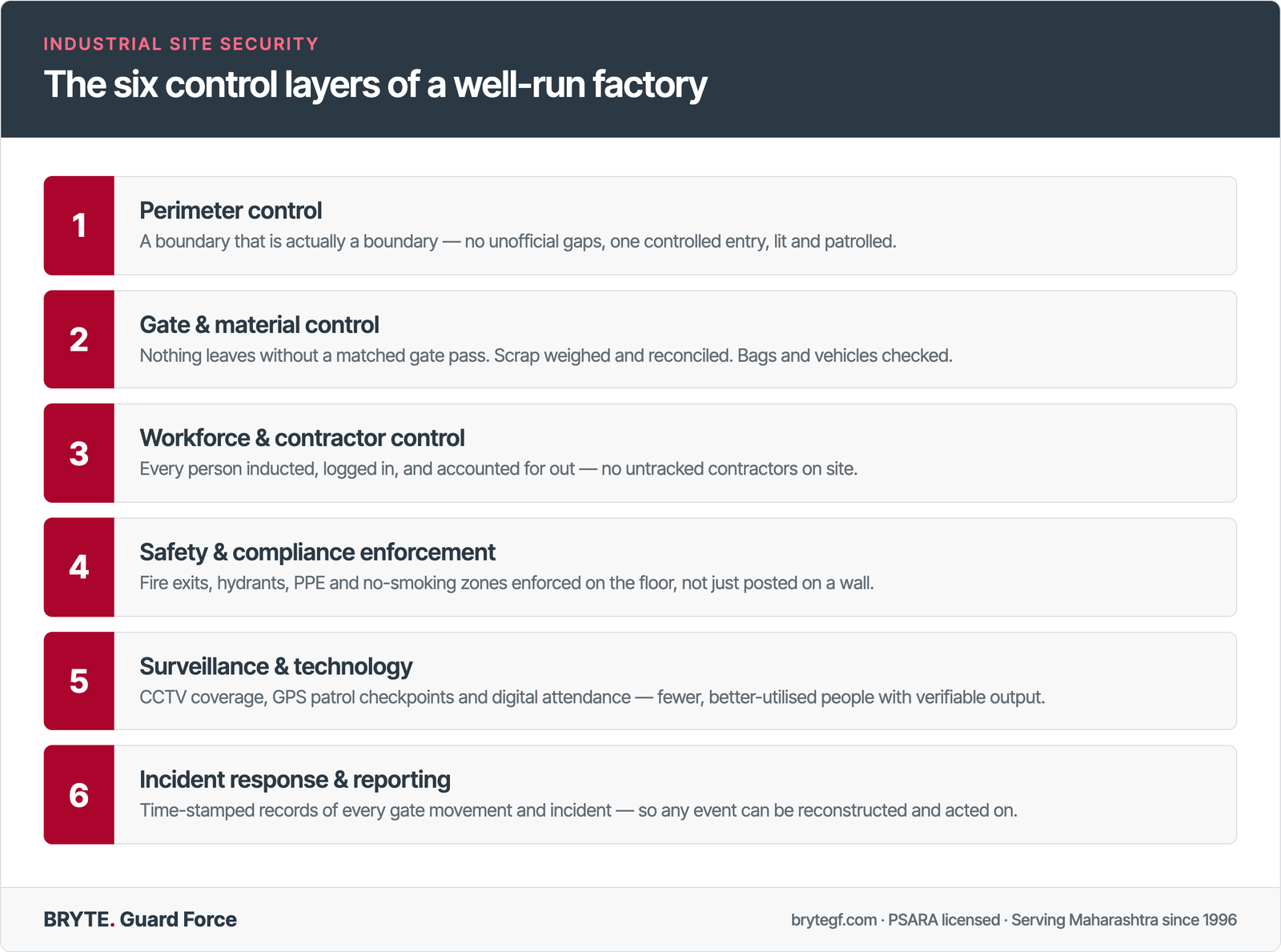
Commercial security protects an asset that sits still. Industrial security has to protect an asset that moves — raw material in, finished goods out, scrap and rejects off-site, hundreds of workers and contractors across shifts, and high-value plant that can’t stop. The threat is rarely a masked intruder; it is leakage, unsafe access, and process indiscipline. A credible programme answers six questions at once:
- Perimeter: is the boundary actually a boundary, or a fence with three unofficial gaps the night shift uses?
- Material movement: can anything leave — in a vehicle, a bag, or a body — without a signed, matched gate pass?
- People & contractors: is every person on site accounted for, inducted, and gone when the shift ends?
- Safety interface: are fire exits, hydrants, PPE zones and no-smoking areas being enforced, not just posted?
- Surveillance & response: when something happens at 2 a.m., who sees it, who moves, and how fast?
- Evidence: can you reconstruct any incident, shift or gate movement from a record — or is it all “the guard said”?
The material gate: where most industrial loss happens
If you fix only one thing, fix the gate. On most manufacturing sites the single largest controllable loss is not burglary — it is pilferage and unbilled material leaving through the main and scrap gates during normal working hours, with paperwork that “looks fine”. A disciplined gate operates on a few non-negotiables:
- Every outward vehicle is weighed or checked against a gate pass that matches an authorised dispatch or challan — no pass, no exit.
- Scrap and rejects are treated as material, not rubbish — weighed, logged, and reconciled to a sanctioned scrap-disposal note. Uncontrolled scrap is the classic revenue leak.
- Contractor and staff bags are checked under a clear, consistently applied policy — inconsistency is what makes checks resented and useless.
- Inward material is verified for quantity and vehicle details so short-supply and duplicate-billing games are caught at the gate, not in an audit six months later.
- Gate registers are digital and time-stamped — a tampered paper register is not evidence.
The right guard force turns the gate from a formality into an audit checkpoint. That single change often pays for the entire security contract several times over.
Maharashtra’s industrial map — and why local deployment matters
Maharashtra is India’s manufacturing heartland, and each cluster carries a different risk profile. A programme that works in Bhiwandi’s warehousing belt is not the programme a Nashik engineering unit or a Nagpur logistics hub needs.
- Pune & Pimpri-Chinchwad: auto, engineering and IT-hardware plants across Chakan, Talegaon, Ranjangaon and Hinjawadi — high contractor churn, valuable components, strict OEM audit expectations.
- Nashik: engineering, wine, pharma and defence-adjacent units at Satpur and Ambad — where compliance discipline and access control are scrutinised closely.
- Nagpur: the MIHAN belt, logistics and power — large perimeters, long approach roads and 24×7 movement.
- Aurangabad (Chhatrapati Sambhajinagar): auto-ancillary and beverage clusters at Waluj and Shendra.
- Bhiwandi & the Mumbai–Nashik corridor: India’s warehousing capital — high-value goods, dense vehicle movement, dock-level pilferage risk. Our 15-point warehouse security audit checklist covers this in depth.
Bryte deploys locally in each of these belts — supervisors who know the cluster, guards who can be relieved and rotated without a coverage gap, and mobilisation that doesn’t depend on bussing people in from another district. City-specific detail lives in our buyer’s guides for Pune, Nashik and Nagpur.
Compliance: the risk that lands on you, not the agency
Industrial buyers carry a specific exposure most don’t price in until an inspection: as principal employer, the factory is liable if its security contractor underpays wages or skips PF/ESIC. A cheap guard quote that undercuts statutory cost is not the agency’s problem in a labour dispute — it’s yours. Three things are non-negotiable when you outsource plant security:
- A valid PSARA licence for the state, plus structured guard training — untrained deployment is both illegal and ineffective. Learn how to verify it in our PSARA compliance guide.
- Full statutory wages with PF/ESIC challans you can inspect quarterly. If the maths doesn’t add up to the legal minimum cost per guard, the shortfall is coming out of the guard’s salary — and eventually out of your compliance record.
- Police verification and ID records for every person deployed, refreshed on rotation.
Bryte is PSARA-licensed and runs audit-ready wage, training and verification records as standard — because on an industrial site, the paperwork is part of the protection.
What industrial security costs in Maharashtra (2026)
Industrial pricing is driven by shift structure, headcount, skill level and site risk. Indicative 2026 monthly bands, per person, inclusive of statutory components:
| Role | Typical monthly cost (per person) | Where it’s used |
|---|---|---|
| Unarmed security guard | ₹18,000 – ₹24,000 | Gates, patrol, general posts |
| Head guard / gate supervisor | ₹22,000 – ₹30,000 | Material-gate control, shift lead |
| Security supervisor / officer | ₹26,000 – ₹38,000 | Site-in-charge, audits, reporting |
| Housekeeping / facility staff | ₹15,000 – ₹19,000 | Integrated upkeep & hygiene |
Inside the Brihan Mumbai & Thane District, guard wages are fixed by statutory Security Guards Board order and revised every January and July — not open to market negotiation. Model your exact headcount and shift structure with our security cost calculator, or read the full 2026 rate guide.
Why integrating security and facility management pays
Most plants run security and housekeeping as two separate vendors with two supervision overheads. Combining them under one accountable partner typically saves 10–15% versus two contracts, and removes the finger-pointing when a boundary issue — a wet floor near a machine, an unlit yard, an unmanned fire point — falls between the two. Bryte’s industrial security service is built to integrate with housekeeping, technical upkeep and parking under a single SLA, so one team owns the whole operational envelope of your site.
How to evaluate an industrial security partner
- Do they survey before they quote? A number without a site walk is a guess. Insist on a mapped structure — posts, shifts, relievers, gate controls.
- Can they show reliever maths? A guard on 12-hour shifts for 30 days straight is a safety incident on a countdown. Real coverage prices in leave and weekly-off relievers.
- Is supervision real? Ask how night patrols are verified — GPS checkpoints and digital reports, or a signature that could be written from home.
- What’s the mobilisation SLA? Bryte replaces an absent guard within hours and mobilises new sites on a committed timeline — not “we’ll try”.
- Reporting cadence: a serious partner sends you incident and gate-movement reports you can act on, and reviews them with you.
Frequently asked questions
What is the difference between industrial security and normal security guards?
Industrial security is a control system, not just manned guarding. It adds material-gate discipline, contractor and workforce control, safety-zone enforcement, and audit-grade reporting on top of standard patrol and access duties — because a factory’s biggest losses are operational leakage, not break-ins.
Are security guards mandatory for a factory in Maharashtra?
While the Factories Act governs safety rather than guarding, most plants require security both for asset protection and to satisfy insurer, OEM and audit expectations. Any agency you engage must hold a valid PSARA licence and deploy trained, verified personnel.
How many guards does a factory need?
It depends on gates, perimeter length, shift pattern and material movement — not a rule of thumb. A free site assessment maps the minimum viable posting, so you’re not paying for over-manning or exposed by under-manning.
Can one agency handle security and housekeeping for a plant?
Yes — and it usually should. An integrated contract shares supervision overhead (typically 10–15% saving) and closes the accountability gaps where security and upkeep meet. Bryte delivers both under one SLA.
How quickly can Bryte deploy at an MIDC site?
After a site assessment, Bryte mobilises on a committed timeline and provides guaranteed reliever coverage so a single absence never leaves a post empty.
Related guides
- Corporate Office & IT Park Security in Mumbai & Pune: A Facility Head’s Guide — securing offices and business parks to an audit standard.
- Warehouse & Logistics Park Security: The 15-Point Audit Checklist — the gate, dock and yard controls that stop pilferage.
- How to Choose a Security Agency in Maharashtra: A 10-Point Checklist — score any agency before you sign.
- How Much Do Security Guards Cost in Maharashtra? The 2026 Rate Guide — the real statutory cost of a compliant guard.
- PSARA Compliance: How to Verify Your Security Agency Is Legal — protect yourself as principal employer.
Secure your plant with a partner that answers for it
Every unmanned gate and uncontrolled scrap movement is a line-item leaking off your P&L. Get a free quote and a Bryte specialist calls back within 4 business hours (Mon–Sat) to schedule a free site assessment — a mapped security structure for your factory, with a real number instead of a guess. Or call +91 86523 45610.