
Ask three security agencies to quote for “one guard, 12-hour shift” in Mumbai and you can get three very different prices. The honest ones cluster around the same floor; the cheap one is telling you something — usually that a guard is being underpaid or that statutory dues are being skipped. That floor is not a matter of opinion. For Brihan Mumbai and Thane District, the Maharashtra Security Guards Board fixes it by law and revises it every six months. This guide lays out the current, official 2026 rates in full, explains exactly what sits inside each number, and shows how to read any quote against the legal minimum — so you can budget accurately and spot an unsafe quote before it becomes your liability.
What the Security Guards Board is — and why it sets your floor
The Security Guards Board for Brihan Mumbai & Thane District is a statutory body that governs the wages, allowances and welfare levy for registered security personnel in its jurisdiction. Where the Board operates, its wage order is not a suggestion — it is the legal minimum cost of deploying a compliant guard. Any agency working in this area must pay at or above these figures, and the Board revises them every January and July, so the number is a moving floor, not a fixed one.
The current order — reference SGB/DA/ALD/2026-2242, dated 5 February 2026 — is effective from 1 January to 30 June 2026. All the figures below are monthly, on an 8-hour-duty basis inclusive of the weekly off. This matters because it is the same jurisdiction that covers the bulk of Maharashtra’s corporate, banking and hospitality demand — Mumbai, the wider MMR and Thane district — which is why these are the rates most buyers actually need.
The official 2026 rates, in full
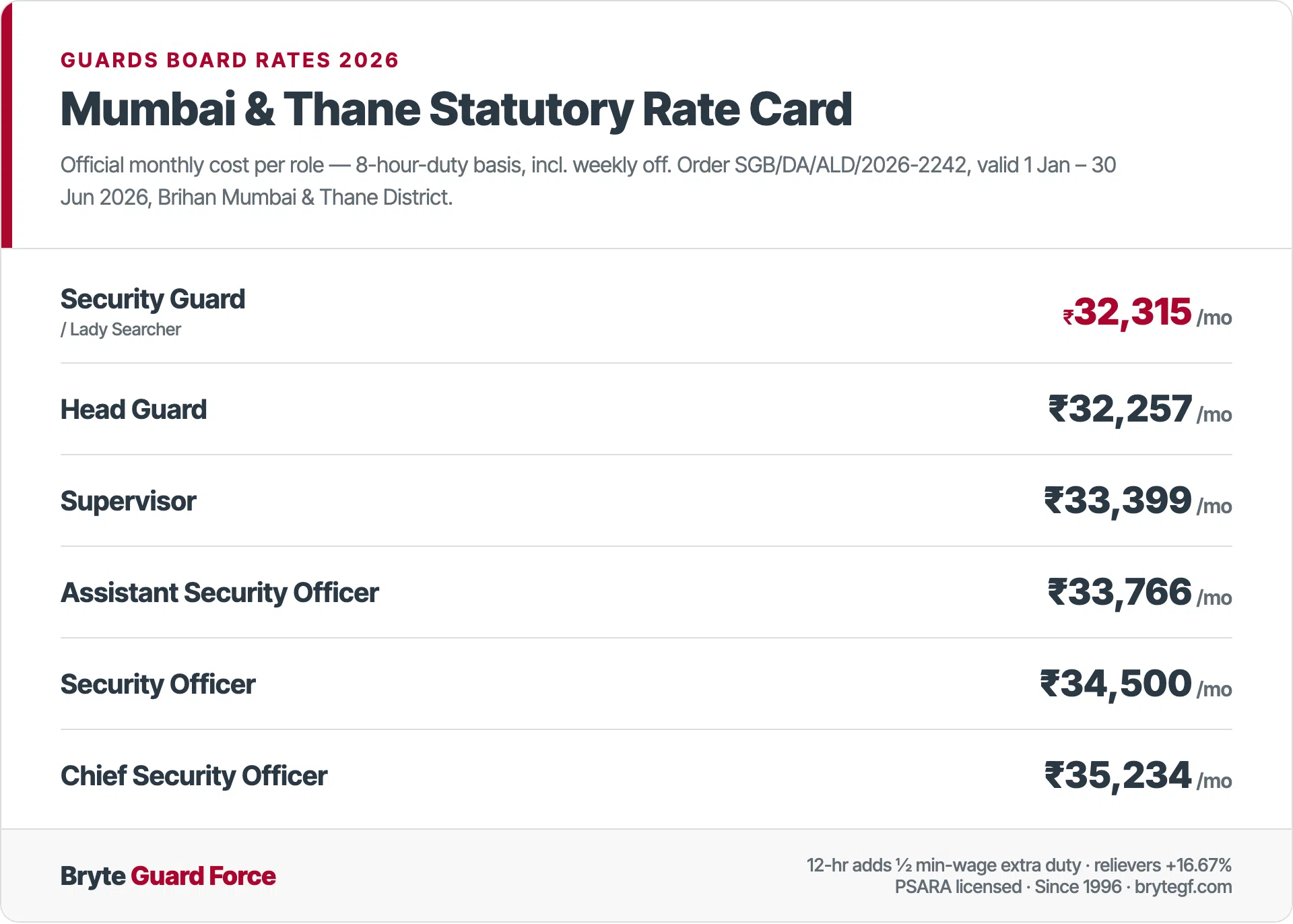
Here is the complete rate card for the current order. The total is what a compliant deployment costs per guard, per month, before overtime and reliever coverage — the amounts we build the security cost calculator on, so this table and the calculator will always agree.
| Role | Wage bundle (₹/mo) | Total statutory cost (₹/mo, 8-hr) |
|---|---|---|
| Security Guard / Lady Searcher | 24,328 | 32,315 |
| Head Guard | 24,658 | 32,257 |
| Supervisor | 25,498 | 33,399 |
| Assistant Security Officer | 25,768 | 33,766 |
| Security Officer | 26,308 | 34,500 |
| Chief Security Officer | 26,848 | 35,234 |
So a single unarmed guard on straight day duty carries a statutory floor of ₹32,315 a month, and a Chief Security Officer ₹35,234. These are per-guard, per-post figures — a site that needs a supervisor plus four guards is costing five lines, not one.
What’s actually inside the number
The gap between a guard’s headline wage and the total cost trips up a lot of buyers, so it’s worth opening up. Take the Security Guard line — a ₹32,315 total built from three layers:
- Minimum wages — ₹17,357. The Board’s basic pay plus dearness allowance. This is the legal wage floor; overtime is calculated on this figure.
- Allowances bring the wage bundle to ₹24,328. On top of minimum wages sit house rent allowance (20% of minimum wages) and other statutory allowances. This ₹24,328 is what reaches the guard as gross wages.
- The welfare levy takes it to ₹32,315. The Board adds a levy — 45.35% of minimum wages for guards (43.10% for officer grades), plus 3.25% on the HRA/allowance components. This roughly ₹8,000 is the Board’s own charge, and it is non-negotiable.
Two consequences follow. First, the total is about 1.3× the guard’s wage bundle — so a quote that looks “close to the wage” has quietly dropped the levy, which is illegal in this jurisdiction. Second, because officers carry a lower levy percentage than guards, the totals compress at the top: the roles are closer together in cost than their titles suggest. For the full arithmetic and how it flows into a per-site budget, see our 2026 Maharashtra security cost guide.
Why 12-hour and 24×7 cover cost more than the maths suggests
The rate card is an 8-hour-duty figure. Most real sites don’t run on 8 hours, and this is where under-priced quotes hide their shortcuts:
- Extra-duty wages for the additional hours. A 12-hour post is not simply 1.5× an 8-hour one. The four extra hours are charged as extra-duty wages on the minimum-wage component (Basic + Special Allowance/DA) — half the minimum wage, about ₹8,680 a month more for a guard, taking the 8-hour ₹32,315 to roughly ₹40,995 for a 12-hour post.
- A round-the-clock post needs relievers. A guard is entitled to a weekly off, so a post that must never be empty cannot be staffed by three guards alone — you need reliever coverage, which adds 16.67% (one guard in six) to a continuous deployment. An agency that prices a 24×7 post as a flat 3× the day rate is quietly assuming the guard never rests, which is neither legal nor sustainable.
This is precisely why two quotes for “24×7 security” can differ by thousands: one has costed the extra-duty hours and relievers honestly, the other hasn’t. Model your own shift pattern with the cost calculator — it applies the extra-duty and reliever rules to whatever coverage you select.
These are Mumbai & Thane rates — what about the rest of Maharashtra?
The Security Guards Board order applies to Brihan Mumbai and Thane District. Elsewhere in the state — Pune, Nashik, Nagpur and beyond — there is no equivalent board wage in force, so pricing follows the market rather than a statutory card, though the underlying Minimum Wages Act and PF/ESIC obligations still apply. Honest indicative bands for a compliant guard look roughly like this:
| Region | Guard (₹/mo, indicative) | Supervisor (₹/mo, indicative) |
|---|---|---|
| Mumbai belt / rest of MMR | 17,000–24,000 | 24,000–38,000 |
| Pune / Nashik region | 14,500–21,000 | 21,000–34,000 |
| Nagpur / Vidarbha & Marathwada | 14,000–18,500 | 20,000–27,000 |
These are market bands, not statutory floors, so they move with local supply and the specific brief. The calculator’s “other districts” mode gives an honest range for these regions; for the exact figure, a site assessment is the only reliable answer. City-by-city context is in our buyer’s guides for Pune, Nashik and Nagpur.
How to read a quote against the floor
Once you know the statutory number, a quote becomes easy to stress-test. In the Board’s jurisdiction, a price below the applicable floor is not a better deal — it is a warning. The money has to come from somewhere, and it comes from one of three places, all of which become your problem as principal employer:
| What a below-floor quote is really cutting | Who carries the risk |
|---|---|
| Underpaying the guard below minimum wages | Principal employer — wage-claim and Board liability |
| Skipping PF / ESIC statutory dues | Principal employer — recoverable dues + penalty |
| Omitting the welfare levy | The agency is operating non-compliantly on your site |
| No costed relievers or overtime | Empty posts, tired guards, and the incident you hired to prevent |
The single best defence is to ask any agency for the wage break-up and last quarter’s PF/ESIC challans, and to compare quotes only at equal scope. Our PSARA verification guide shows how to check an agency’s licence in ten minutes, and our 10-point selection checklist covers the rest of the conversation. For armed and supervisory roles — common in banking security — the same floor applies, with the arms licence and ex-servicemen profile costed on top.
Budgeting across the January revision
Because the Board revises rates every January and July, a 12-month budget should assume a step-up mid-year rather than a flat figure. The increases track dearness allowance and tend to be incremental, but they are real — a contract signed on the January card will legally cost more from July. A good agency will tell you this upfront and build the revision into a multi-year proposal; one that promises a flat rate for two years is either absorbing a loss it will later claw back or planning not to pass the raise to the guard. Ask how revisions are handled before you sign, not after.
Frequently asked questions
What is the security guard rate in Mumbai in 2026?
Under the current Security Guards Board order (SGB/DA/ALD/2026-2242, valid 1 January–30 June 2026) for Brihan Mumbai & Thane District, the statutory monthly cost of one unarmed security guard on 8-hour duty is ₹32,315, rising to ₹35,234 for a Chief Security Officer. Twelve-hour and 24×7 posts cost more because of extra-duty wages for the additional hours (half the minimum wage) and reliever coverage (16.67%).
Are the Security Guards Board rates mandatory?
Yes, within the Board’s jurisdiction (Brihan Mumbai & Thane District). The order sets the legal minimum wages, allowances and welfare levy for registered security personnel, and agencies must pay at or above it. A quote below the applicable floor means someone is being underpaid or statutory dues are being skipped — a liability that lands on you as principal employer.
Why does a 24-hour guard cost more than three times a day guard?
Two reasons. Hours beyond the 8-hour duty are charged as extra-duty wages — for a 12-hour post, the four extra hours add half the minimum wage (about ₹8,680 for a guard), so it is not simply 1.5× an 8-hour one. And a post that must never be empty needs relievers to cover weekly offs, adding 16.67% (one guard in six) to a continuous deployment. An agency pricing 24×7 as a flat 3× the day rate has not costed rest days or extra duty.
Do these rates apply in Pune, Nashik or Nagpur?
No. The Security Guards Board order covers Brihan Mumbai and Thane District. In other Maharashtra regions there is no board wage in force, so pricing follows market bands — though the Minimum Wages Act and PF/ESIC obligations still apply. Indicative guard bands run roughly ₹14,500–21,000 in the Pune/Nashik region and ₹14,000–18,500 in Vidarbha, with a site assessment giving the exact figure.
What happens if I pay below the Board rate?
As principal employer, you can be held liable for a contractor’s unpaid wages and statutory dues, plus penalties — so a cheap quote can cost far more than it saves. Beyond the legal exposure, below-floor pricing usually means no relievers and underpaid, high-turnover guards, which is exactly how a security programme fails. Insist on the wage break-up and PF/ESIC challans before you sign.
Related guides
- How Much Do Security Guards Cost in Maharashtra? The 2026 Rate Guide — the full costing arithmetic behind these figures.
- PSARA Compliance: How to Verify Your Security Agency Is Legal — check any agency’s licence in ten minutes.
- How to Choose a Security Agency in Maharashtra: A 10-Point Checklist — compare partners at equal scope.
- Bank, ATM & Vault Security in Maharashtra: A Branch Manager’s Guide — where armed and ex-servicemen postings sit on top of this floor.
Turn the rate card into your exact number
The Board sets the floor; your site sets the rest — shifts, headcount, armed or unarmed, security-plus-housekeeping. Model it in seconds with the Bryte security cost calculator, then get a free quote and a specialist calls back within 4 business hours (Mon–Sat) to turn it into an exact, compliant, site-assessed proposal. Or call +91 86523 45610.